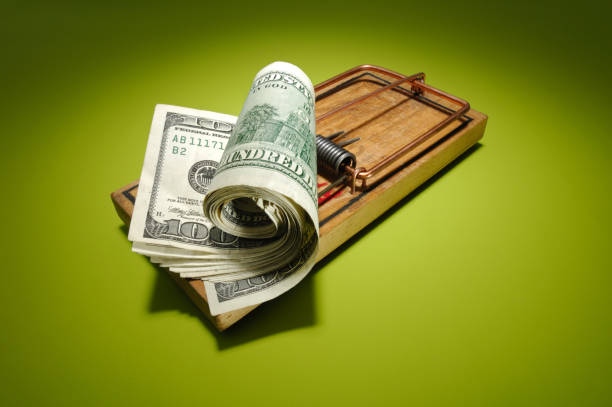
When you get your credit card statement, you see a number that looks surprisingly small. It says “minimum payment due” and might be just $25. For many middle-class consumers, that number feels like a gift. But it can turn into a lifetime of debt. The problem is not laziness. The problem is that most of us were never taught how credit really works. That lack of knowledge is called financial illiteracy. And one of its most dangerous effects is the minimum payment trap.
Here is how the trap works. When you carry a balance on a credit card, the company charges interest every month. Your minimum payment is usually a small percentage of that balance, often 1% or 2% plus fees and interest. So if you owe $2,000 at a 20% annual percentage rate, your minimum might be around $40. Of that $40, most goes to interest. Only a few dollars reduce what you actually borrowed. The next month, interest is charged again on the remaining balance. So you keep paying, but your debt barely moves.
Consider a real example. You owe $3,000 on a card with a 22% APR and a 2% minimum payment. Making only the minimum means it will take over 25 years to pay off the debt. You will pay more than $7,000 in interest alone. That $3,000 purchase ends up costing over $10,000. And that assumes you never use the card again. Most people do. So the trap gets deeper.
Why do companies allow such small minimums? Because it benefits them. The longer you take to pay, the more interest they collect. A low minimum keeps you on the hook for years. It feels easy, which encourages more spending. The companies know that many consumers do not understand compound interest or how long it really takes to pay off a balance. That is financial illiteracy.
Financial illiteracy is not about being dumb. It is about not having the right information. Most schools do not teach personal finance. Many parents just say “don’t use credit.“ So people learn by trial and error, and errors are costly. If you knew that paying only the minimum would triple your cost, you would likely make a different choice. But nobody told you. The credit card statement does not say “you will be paying this for 25 years.“ It just says you owe $40.
What can you do? First, understand that your credit card is not free money. It is a loan with a high interest rate. Second, always pay more than the minimum. Even $50 extra a month can cut years off your payoff time and save thousands. Third, read your statement carefully. Look at the “interest charged” line. That is real money leaving your pocket.
Another key lesson is to know your APR. That is the annual percentage rate. A store card might have an APR of 28%, which is enormous. A regular card might be 18% or 20%. If you have good credit, you might qualify for a lower rate. But even a few percentage points matter a lot over time. A $5,000 balance at 18% costs less than half the interest of the same balance at 28%.
The minimum payment trap is not a personal failing. It is a system designed to keep you in debt. The only way out is to learn how it works and then take action. You do not need to be a finance expert. You just need to know that paying the minimum is almost always a mistake. If you can only afford the minimum today, that is okay. But make a plan to pay more as soon as possible. Even an extra $10 a month helps. The important thing is to stop treating the minimum as your goal. Your goal should be to own what you buy, not to rent it forever from a credit card company.
Financial literacy gives you power. It helps you see through the numbers on your statement. It helps you realize that a small monthly payment can hide a huge lifetime cost. So read, watch, ask questions. The knowledge you gain will save you real money. And that is something every middle-class household can use.