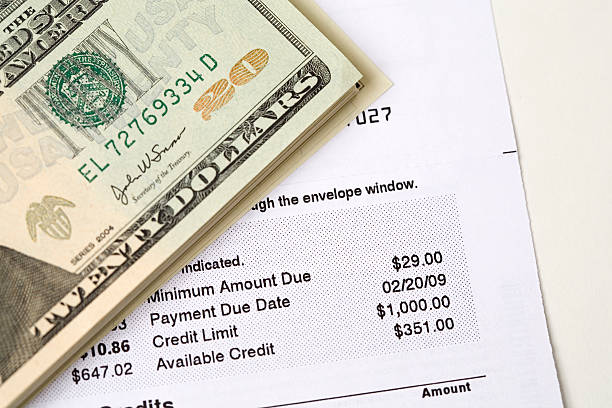
Most people who carry a credit card balance do not truly understand what happens when they pay only the minimum amount due each month. The credit card statement says something like “Minimum Payment Due: $35” and many consumers assume that as long as they send that amount, they are handling their debt responsibly. In reality, paying the minimum is one of the most expensive habits a middle-class consumer can develop. It turns a manageable purchase into a decade-long financial burden, and it quietly undermines the very goal of building good credit.
Here is how the math works. Suppose you have a credit card with a $3,000 balance and an interest rate of 20 percent per year. The minimum payment on most cards is calculated as a small percentage of your balance, typically 1 percent to 2 percent, plus any interest and fees. For a $3,000 balance, that minimum might be around $60. If you send in exactly $60 each month and never charge another dollar, you might expect to pay off the debt in a few years. The reality is far worse. Because interest accrues daily, a large portion of that $60 goes straight to the card issuer, not to reducing what you owe. At a 20 percent annual rate, the interest on $3,000 is roughly $600 per year, or about $50 per month in the early stages. That means your $60 payment is only taking about $10 off the actual balance. The debt shrinks at a snail’s pace.
If you continue paying only the minimum, it will take you over 20 years to eliminate that $3,000 balance. In that time, you will pay more than $5,000 in interest alone. That means a television you bought for $3,000 ends up costing you over $8,000. And that assumes you never use the card again. The moment you add a new purchase, the repayment clock resets, and you fall deeper into a hole that grows faster than you can dig yourself out.
The trap is even worse because minimum payments change. As your balance slowly comes down, the minimum payment also drops, which seems like good news. But a lower minimum payment means an even smaller slice of each payment goes toward the principal. You end up treading water for years, making steady payments while the balance barely moves. This is not an accident. Credit card companies design this system to maximize the interest you pay. They profit when you borrow more and pay slowly. The minimum payment is not a tool to help you get out of debt. It is a tool to keep you in debt.
Many middle-class consumers fall into this trap because they mistake their credit limit for the amount they can actually afford. The card issuer approves a $10,000 limit, and the consumer believes that means they have $10,000 of available money. But a credit card is not money. It is a short-term loan with a double-digit interest rate. When you carry a balance, you are paying a penalty for every item you bought weeks or months ago. The store’s “interest-free” financing or the “rewards points” you earned become meaningless when you are paying 20 percent interest on the same purchase.
Financial illiteracy is the core problem here. Most people were never taught how compound interest works in reverse. They understand that saving money in a retirement account grows over time, but they do not realize that credit card debt shrinks in the opposite direction. The same exponential math that builds wealth when you are saving works against you when you are borrowing. Every dollar of unpaid balance generates new interest, and that interest generates more interest the next month. Before long, you are paying interest on interest. This snowball effect is silent and invisible on your monthly statement, but it is the single biggest reason middle-class families struggle to get ahead.
The fix is not complicated, but it requires breaking the minimum payment habit. First, you must find out the true interest rate on your card and understand how much of your current payment is going to interest versus principal. Then you must commit to paying a fixed amount each month that is well above the minimum. Even an extra $20 or $30 makes a huge difference because every extra dollar goes directly against the balance. Second, you should stop using the card completely while you are paying down the balance. If you cannot use cash or a debit card, then you cannot afford the purchase. Third, consider a balance transfer to a card with a lower interest rate, but only if you read the fine print and understand the fees and the time limit on the promotional rate. The goal is to pay off the debt, not to move it around and celebrate a lower monthly bill that still lasts for decades.
Most importantly, change your mindset. A credit card is a convenience tool, not a source of money. The only healthy way to use a credit card is to pay the statement balance in full every month. If you do that, you never pay interest, and you actually build a strong credit history for free. If you cannot do that, then you are borrowing at a terrible rate, and the smartest financial move is to treat that debt like an emergency. Paying the minimum is not a sign of responsibility. It is a sign that you are losing the battle with compound interest. The way out is not clever tricks or quick fixes. It is simply paying more than the minimum, month after month, until the balance is gone. That is the hard truth that too many consumers never learn until they have wasted years and thousands of dollars.